




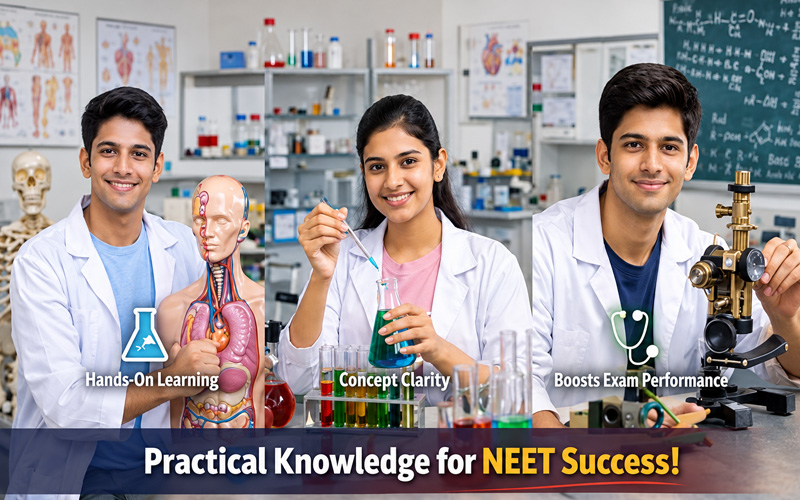
Science labs play a crucial role in NEET preparation, primarily by bridging the gap between theoretical knowledge and practical application, which is essential for understanding complex concepts in Biology, Chemistry, and Physics.
While NEET is a theoretical exam, practical experience enhances conceptual clarity, improves memory retention through experiential learning, and aids in tackling application-based questions.
Recent trends in NEET indicate an increase in questions based on the practical skills.
Hands on Learning - Engaging multiple senses - seeing, doing and recording : helps in better long term retention of facts compared to rote memorization. Focus and Attention - Working in a lab environment requires concentration and discipline which enhances analytical skills and helps students stay focused on understanding the "how" and "why" behind scientific phenomena.
Problem Solving - Labs promote critical thinking by encouraging students to analyse results, identify mistakes and correct them. This develops a logical, analytical and scientific temperament.
Confidence Boost - When a student understands the practical application of a theory, it boosts their confidence in tackling complex or unfamiliar questions in the NEET exam hall.
The NEET syllabus is based on NCERT, and NCERT explicitly includes practicals and experiments for Classes 11 and 12. The Lab practices ensure that students are familiar with all experiments mentioned in the NCERT curriculum.
In summary, for students aiming for top notch scores, the science lab is an indispensable tool that converts abstract, theoretical knowledge into concrete, understandable and memorable facts.
At Iris Classes, we have well equipped separate Science Labs. Our faculties primarily goal is to ignite the students curiosity and interest by offering dynamic, hands on experiences about the science topics in the lab.

Choosing the right educational institution is one of the most important decisions that you as a parent can
take in your child's life.
From the first step in the school to leaving the school with confidence & competence of an intellectual
stimulating career, the school plays a very important role in the academic & social advancement of the
student.
Copyright @ 2026 Shri G.P.M. Junior Colleges, Iris International Schools & Iris Classes
Website Designed by Mirackle Solutions